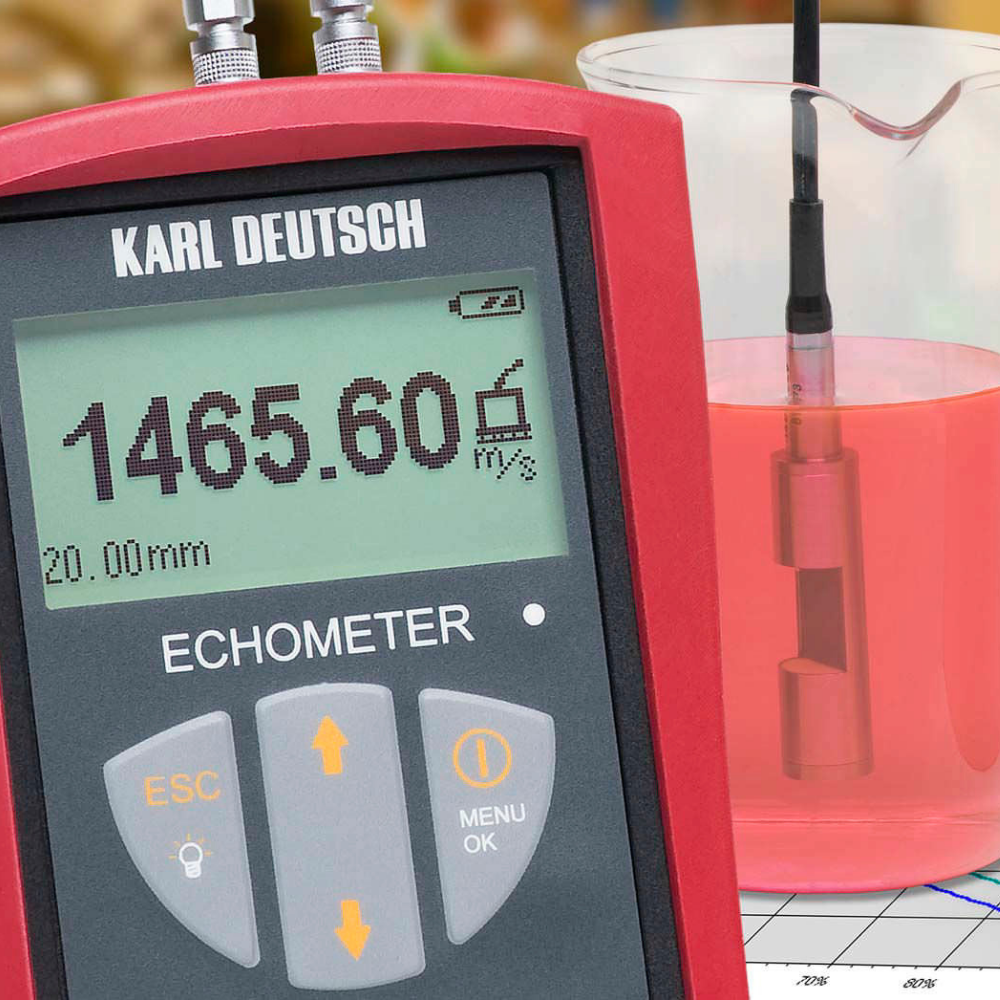
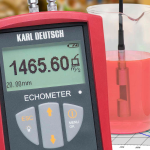
By means of a special probe immersed into the liquid the ECHOMETER 1076 K determines the sound velocity of the liquid, which is a measure of the substance concentration.
The ECHOMETER 1076 K is an instrument to measure the sound velocity of liquids.
The accompanying probe is designed like a cuvette and simply gets dipped into the liquid for measurement.
Each an ultrasound transmitter and a receiver are included in the probe. Their piezo elements are covered by a protective layer to prevent damage by chemically aggressive liquids to be measured.
Subject of measurement is the time that is required for the sound to run through a constant, defined path between transmitter and receiver being submerged in the liquid.
Then the sound velocity becomes calculated by the electronic evaluation unit and is shown on the display of the gauge.
The velocity of sound in a material is a material constant depending on its chemical nature. Every chemical compound has a different velocity of sound propagation. With binary systems the velocity of sound of the system changes characteristically depending on the composition. Fig. 1 shows this interdependence, using the compound methanol-water as an example.
If the dependency of concentration is known (calibration measurement) you may determine the given composition by a measurement of the sound velocity.
The suitability of the device for use in the field of quality assurance of chemical products is shown by the the following application example. Subject of the examination was a commercially available anticorrosive as it is mainly used with cooling lubricants (for cutting metal processing).
The sound velocity of some known liquids is compiled in the following table. With compound liquids it can be assumed that the determination of concentration by means of the measurement of sound velocity is the more promising the more the sound velocities of the individual (pure) components differ from each other.